About Us
Welcome to the Environmental Humanities!
We prepare you to promote ethical environmental solutions by studying how culture shapes our life with nature while contributing to healing beyond the classroom.
For video production special thanks to Christian Clark (College of Arts & Sciences Social Media Coordinator), Anna Ingram (Environmental Humanities Minor and Leadership Team Student Representative), Elise King, and Jon Davis (Video Production Manager, Marketing and Communications).
What Is "Environmental Humanities"?

The health of culture and nature are interconnected. From trees to rivers and bees, countless members of creation sustain our lives and inspire our imaginations. We fashion our cultures with them, from fibers in our clothes, to food we share, to sanctuaries where we worship. And our treatment of creation and each other is powerfully informed by what we value and dismiss, imagine and tell stories about, and advertise or overlook.
Environmental Humanities is a multidisciplinary field that asks how the health of cultures, creation, and our neighbors are interconnected. Environmental Humanists integrate insights from disciplines that analyze and express human culture—the humanities and arts—with those from the social and natural sciences. They seek to understand how values, imaginations, beliefs, and diverse cultural contexts shape the ways people inhabit and transform environments, for good or ill. Studying Environmental Humanities prepares you to contribute to ethical and culturally effective environmental solutions through a wide range of professions.

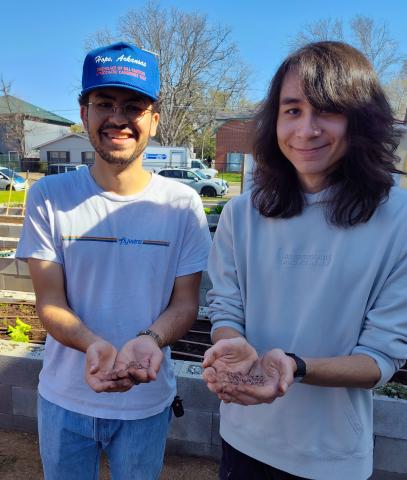
In Baylor's Environmental Humanities program, you select from a rich offering of environmentally focused courses in the arts and humanities and flexibly combine them with options from the social and natural sciences as well as healthcare, law, and social work. We pair thinking across disciplines and cultures with hands-on, engaged learning that contributes to healing beyond the classroom. Many classes particpate in locally grounded initiatives that give you globally relevant experience by advancing food security, environmental resilience, community wellbeing, and a culture of creation care.
Why Study Environmental Humanities?

This versatile path of study prepares you to cultivate the wellbeing of people and environments in culturally informed and effective ways through a wide range of callings. These include education, the arts and creative writing, journalism, ministry, public service, law and policy, public and mental health, national parks, sustainability leadership, science communication, nonprofit direction, community organization, and more.
You might become an environmental lawyer defending clean water for communities and ecosystems; a pastor preaching on creation care; a teacher helping children cultivate wonder for the living world through outdoor learning; a journalist exposing unequal concentration of toxic waste in communities; a national park historian preserving local history along with ecological resources; a community organizer working for healthy local food and green spaces in urban neighborhoods; a climate scientist sharing your findings with audiences of non-specialists; or a novelist exploring astonishing and vulnerable ways human lives are entangled with the natural world—to name just a few.
And no matter where life takes you, studying Environmental Humanities provides you with the time, tools, and experiences to reflect on your own engagement with the planet in ways that can transform your everyday life.
We’d love to welcome you into our community!
Click here to read what students say about the program.