

Finding Renewal by Creating Renewal
by Chayse Bothwell for Dr. Joshua King’s ENGL 4365: Literature and Environmental Justice class, Fall 2025.
Welcome
Welcome to my page! Over the course of a semester I was given the opportunity to read works about environmental injustice from a multitude of diverse perspectives, in which I learned about the ways that different communities have been affected. Hearing firsthand how environmental injustices can affect people's health and way of life as well as learning about the direct relationship between the environment and identity really inspired me to want to help our planet in any way that I can. My hope for anyone who comes across this page is that they realize that we do have the power to be the change that we want to see in the world, and by helping to renew our communities, we can find renewal within ourselves too.
Reflection
I never used to consider myself much of an outdoorsy person. I liked studying outside, going on walks, things of that nature, but I never gardened or did any tangible work in or for the environment. My grandfather’s a farmer, and growing up I would visit his farm in Maryland and watch in awe as his weathered hands from years of work pulled crops like corn, tomatoes, and soybeans out of the dusty ground. Despite this, I never once participated. I watched, but never got my hands dirty. I didn’t understand then the power and importance of the work that he does.
Flash forward to fall 2025, which is when I decided to take Dr. King’s Literature and Environmental Justice class as a part of my English minor. Within the class I had the opportunity to volunteer with Urban REAP, an environmental organization that’s a part of Mission Waco, a large charity here in Waco. I remember arriving at Urban REAP on a beautiful September day, completely unaware of how I would leave changed for the better. Inside Urban Reap there were dozens of different kinds of plants, tons of bags of soil, and the biggest composter that I had ever seen.
For the majority of the time that I was at Urban REAP, I was tasked with shoveling turkey litter, a type of fertilizer, into 5-gallon bags. The fertilizer crumbled like chocolate cake as I scooped trowel-full clumps into the bags. As I worked, there was a soft breeze that delicately blew strands of hair across my face. Birds chirped and small bugs buzzed around me. I got into a good rhythm of shoveling. Bagging. Tying up the bag. Next bag. Over and over and over again. I was a machine. Eventually I ran out of turkey litter, but I had over twenty bags done, and a new callous on my hand–a visual symbol of the labor that went into my work. I had assumed at this point that I had only been working for about thirty minutes or so. To my surprise, however, it had been over an hour. In my day-to-day life I’m so used to watching the clock, waiting for time to slip away. In a boring lecture, or during a long day of work, we want time to pass, yet it always feels like it’s moving so slowly. But in that moment, outdoors, engrossed in my work and in my own thoughts, time had gotten away from me, and for the first time in a long time, I didn’t even notice.
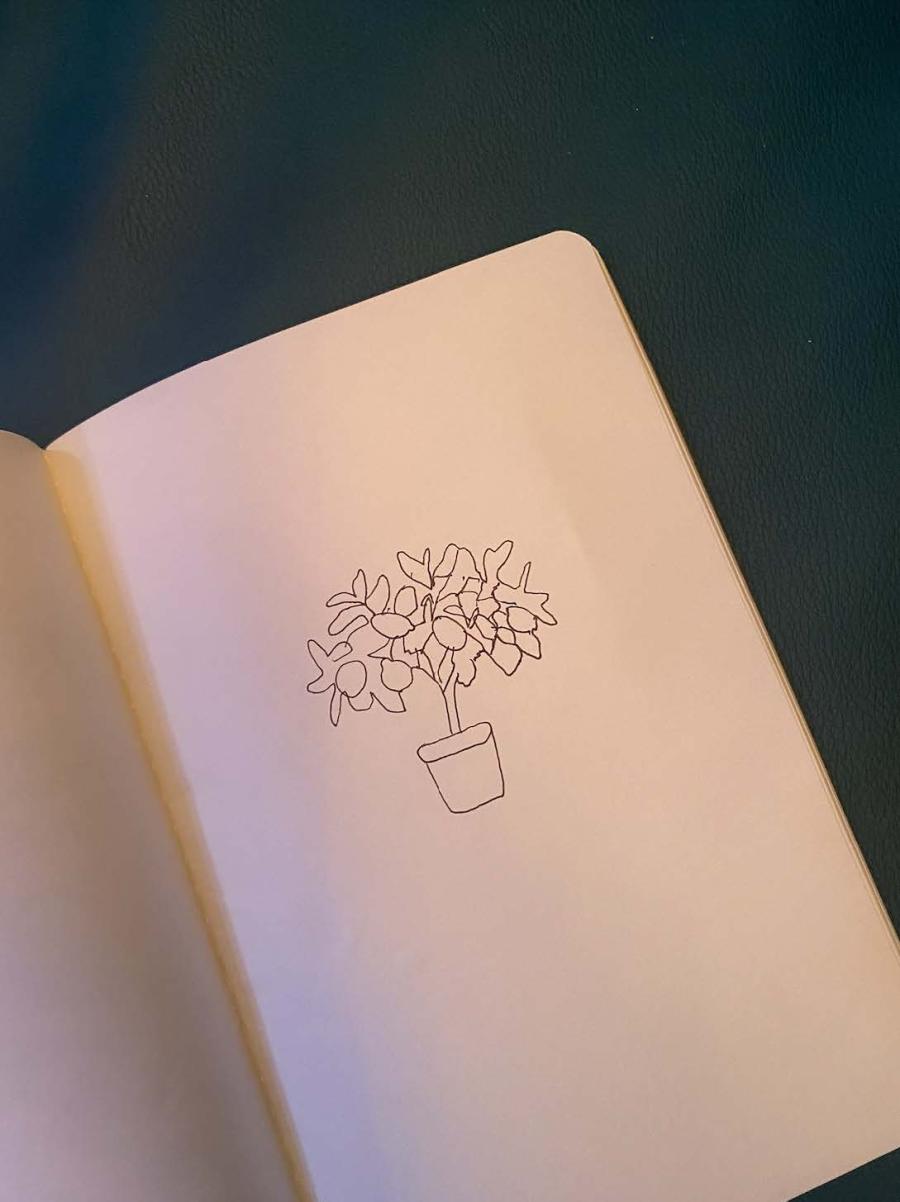
Later, near the end of my scheduled volunteer time, the director of Urban REAP, asked if my classmates and I wanted to assist in planting a lemon tree. It had been sitting dormant in an old wooden container for years, and it needed to be moved outside so it could bloom and blossom. I agreed, and equipped with some yellow and black gloves, I helped hoist the tree out of the bin that it had been sitting in, and into a much bigger one. As we moved the tree into its new home, I couldn’t help but think about the word revival. It truly felt as though I had brought new life to something, and all it took was four students taking a couple hours out of their weekend for this tree’s life to be significantly uprooted and changed for the better. So much good can be done by giving the Earth just a little of our time.
Looking back on this experience, I really appreciate the stillness that it gave me. For college students especially, life can be so overwhelming. I’m constantly thinking about what comes next, what homework is due, or what needs to be done, that it’s so hard to ever feel present. Forcing myself to just stop for two hours on a day where I normally would’ve just done homework all day or doom-scrolled for those two hours, really made me realize how much value there is in slowing down. I felt like I could really appreciate the beauty of Earth for a moment. I could see the beauty in dirt, the uniqueness in each grain. The beauty in the flies that I normally swat away. And most importantly, the beauty in life, in the world that we have all around us that we consistently forget about. It’s easy to look at all the problems in the world and at environmental decay and to just feel hopeless about it all. To feel trapped. But I don’t think what people realize is how much change can be done on an individual level. It’s not as impossible as it may seem.
When you tend to the Earth, not only are you renewing it, but you are renewing yourself. There is power in stillness and there is power in action. One small act can start a chain reaction. If a couple pairs of hands can bring new life to a dying lemon tree, imagine what good your hands can do. Creation is within all of us, and I look forward to continuing to plant seeds of change all around me as I believe it is what we are meant to do.
Creative Invitation
Introduction
During my time in Dr. King’s class, I always found myself drawn to works based on someone’s personal experiences. I had the opportunity to read numerous works by Kathy Jetñil-Kijiner, a poet from the Marshall Islands, and the majority of her poems were about the Marshall Islands, herself, her heritage, and what injustices she herself and her people faced. Two poems of hers that particularly stood out to me were “History Project” and “Fishbone Hair.” These poems drew from things Jetñil-Kijiner experienced while growing up, as well as a tragedy that she faced in her own family because of the effects of nuclear fallout in the Marshall Islands. Her poetry is so moving because of the personal elements and stories that she chooses to include, as well as the intentional shapes of her poem. She uses form to tell a story just as much as she uses words, which gives her work such great depth. Within my own work, I am aiming to invite readers into pockets of my life, in the hopes that my experiences with nature may emphasize how important it is to cultivate renewal or refugia in the world around us.
Furthermore, I have also found myself inspired by Melissa Tuckey and her poem “Ghost Fishing Louisiana” about "Cancer Alley," a corridor along the Mississippi River from Baton Rouge to New Orleans with over 150 chemical plants and oil refineries. Like Jetñil-Kijiner, Tuckey shares how a community’s exposure to toxic chemicals has led to travesty. She writes, “Her house held the cancer / like fish in a locked box” (14-15). This notion that cancer surrounds the community helps us understand the danger they face merely by existing, and encourages action so that they may escape the fate in which they feel trapped in. While I haven’t faced the same challenges that Jetñil-Kijiner and those in Cancer Alley have, the passion that I have for the environment was very much shaped by experiences I had growing up, and I hope to use my unique personal perspective to call for change.
Additionally, a lot of the other poems that I read in Dr. King’s class intertwined fiction with statistics to emphasize the severity of the environmental crisis that we are currently in. In Dan Vera’s “Abecedarian Yellow”, he reflects on the banana, and how it, along with many other crops, have been genetically modified. He purposefully includes details like,
“P is for “Panama Disease, which wiped out
the last variety of shippable bananas in the 1950s
and may soon wipe out the current one” (31-33).
And, “J is for junta, with an h-like j from the Spanish,
as in “military junta” set up by intervention to sustain control
and ensure cheap labor in countries like Honduras and Guatemala
so that bananas can get to your table cheaper
than an apple which grows in your yard” (19-23).
These striking facts help break up the poem, and draw attention to the problem at hand. I was inspired by this to incorporate statistics into one of the poems that I wrote, in order to emphasize what I believe to be an important health crisis, and to hopefully encourage readers to want to make change, as they finally understand the gravity of what we face. May these poems encourage you to not run away from reality, but rather to face it head on.
Monkey Bars
When I was a kid,
My primary concern was the jungle gym.
I’d wipe my sweaty palms off on my wrinkled shorts.
Like a ducking flapping its wet, swollen wings.
Then I’d extend my hands and swing
From rung to rung.
Legs dangling high above the woodchips.
Everything below seemed so small.
I’d go home everyday with callouses.
A symbol of my prowess.
But then growing up got in the way.
And I forgot about my talent.
No more recess in middle school.
It was time for growing up.
I went outside for the walk to school and back.
Nothing more.
Eight years later,
Here I stand, a shovel in hand.
I run my fingers down the long, oak handle.
This thing might be taller than me.
Using the shovel I scoop up dirt.
It crumbles like a pastry.
I like the smell of Earth.
Bitter, yet refreshing.
When I finished my task,
I noticed a new callus on my hand.
In the same spot
Where one once was.
For a moment, I’m a kid again.
Velcro sneakers dangling
From blueberry blue monkey bars.
I’m free-hanging.
Blistered hands are a sign of mastery.
What a joy is innocent outdoor shenan-igry.
I get this weird image in my head.
Of myself hanging from a suspiciously shovel-shaped monkey bar.
Perhaps there’s a way to feel free again.
Made with Artificial Coloring
Two dark orbs.
Black holes in snow.
Fur the same color as the
Bleached white cookie mix
That I’m using.
I try to ignore the label
As I shake the tin of
Rainbow sprinkles.
They look like Christmas lights
in the dough.
Dye
down my throat.
It coats it like spray paint.
My tongue is stained.
I love the color of artificial red.
When I see photos of polar bears.
They often look yellow to me.
Bodies stricken with what looks like disease.
But really it’s hunger.
I’m telling you, they’re hungry.
Scientists estimate that
By the end of the century,
Almost all of the polar bears
Could be gone.
Does it have to be this way?
Sapphire blue oceans muddied
By 5.25 trillion pieces of plastic.
Yes, the clear plastic straw
That you use at dinner
Makes a difference.
Green lush trees
Catch on fire.
Orange embers engulf.
Black ash reins.
“It’s all natural”, they say.
The world is a rainbow,
And we’re draining it of its color.
Replacing real dyes
With synthetic ones.
I wonder when was the last time I saw something for what it truly was?
Yellow No. 5 Green No. 3
Red No. 40 Blue No. 1
This is our rainbow now.
It’s in our candy, our soda,
Our cereal, and our medication.
What can I say, we like our colors vibrant.
Brighter and better than the God-given ones.
But I dare you to think about
The Scarlet Ibis.
The Bluebonnet.
The Yellow Tang.
The Emerald Tree Boa.
The world is a palette.
Our existence, the canvas.
Please see the bigger picture.
We have to protect it.
Works Consulted
Jetn̄il-KijinerKathy. Iep Jāltok : Poems from a Marshallese Daughter. Tucson, The University Of Arizona Press, 14 Feb. 2017.
Polar Bears International. “Status | Polar Bears International.” Polarbearsinternational.org, 2021, polarbearsinternational.org/polar-bears-changing-arctic/polar-bear-facts/status/.
Thomme, Gina Van. “Are Food Dyes Unhealthy?” MD Anderson Cancer Center, 25 Apr. 2025, www.mdanderson.org/cancerwise/are-food-dyes-unhealthy.h00-159775656.html.
Tuckey, Melissa. Ghost Fishing : An Eco-Justice Poetry Anthology. Athens, The University Of Georgia Press, 2018.