

Non-Human Creation as Teachers
by Travis Gould for Dr. King’s ENGL 4365: Literature and Environmental Justice class, Fall 2025
Welcome
Welcome and thank you for taking the time to visit Teal Community Garden! I hope you enjoy reading my reflection on tending to this garden and even more so on the importance of viewing humanity as a part of creation, in which all beings are interconnected. If there is one thing you can take away from this reflection and creative poem, it is the practice of gratitude when approaching the creation that is all around you. I hope that you can find and know gratitude today!
Reflection
It had been a long, hard day, and I felt exhausted as I clambered into my car after work. I work as an after-school tutor through a non-profit at a local elementary school, and every day I oversee about thirty students from 3rd to 5th grade. Most days, I leave work feeling full, having spent my time and energy teaching and guiding students. It is meaningful work that I thoroughly enjoy. However, on this particular fall day, work had been extremely draining, as I was discouraged by the behavior of a few of my students. Driving home from work, I couldn’t help but feel dejected, as if I were making no impact with my students. All I wanted to do was go home, eat dinner, and fall asleep. Instead, I drove to Baylor’s Teal Residential dorm, where, as part of Dr. King's class, I participated in tending to the newly planted Teal Community Garden.
Early in the semester, as part of Dr. King's class, my fellow students and I had planted pollinator plants in the Teal Community Garden. Over the semester, we tended to the garden by weeding, watering, and observing the overall health of the plants. In particular, we cared for and tended to Milkweed, the only food source for monarch caterpillars. Hungry and weary from work, I arrived at the Teal Community Garden. The sun was setting, and the air was crisp with cold as I walked through the garden, noting which plants were thriving and which were struggling. My mind was still focused on my students as I began watering the plants. However, as I watered the plants, my thoughts turned from my students to the soil and the plants. I became fascinated as the soil greedily soaked up the water. I knew that in turn, the plants would soak up nutrients from the soil, leading to their growth and flourishing. As I finished watering the plants, I put up the hose and went back to the garden and stood in the midst of plants still dripping water, breathing in the smell of wet soil.
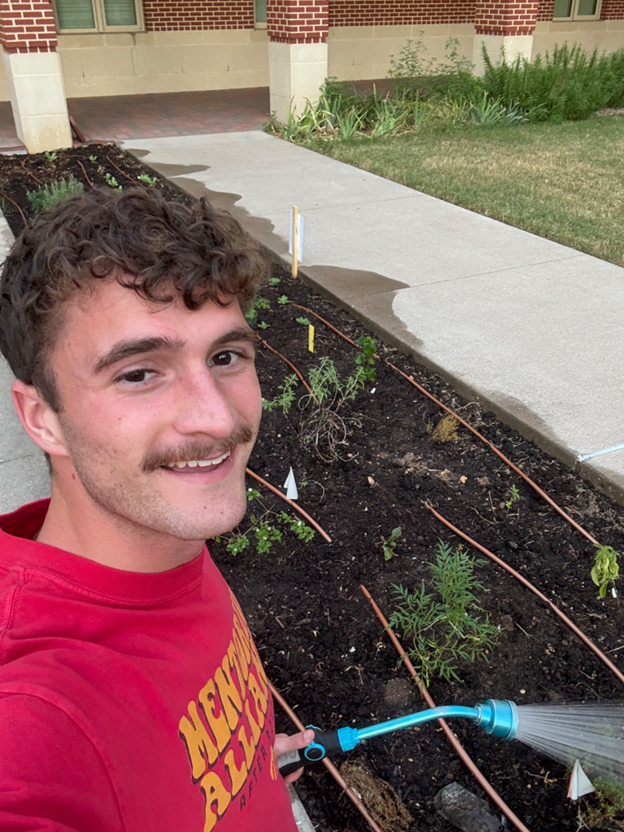
Leaving the garden, I was still tired and very hungry, but I was no longer discouraged about my day at work. In watching the soil drink deeply, I had been reminded that my students were much like soil. Alongside parents, teachers, and friends, I was watering and tending to the soil of my students, investing in them and their future. Gardening is a slow process. Much effort and care are required to bring forth a plant's yield. It is easy to grow discouraged when your effort is not rewarded by growth. But, like the roots of plants, growth often is undiscernible, often even only becoming apparent years later. Thus, leaving Teal Community Garden, I was reminded and encouraged to approach my students with patience, tending to and caring for them despite their behavior or actions. Moreover, as I left the Teal Community Garden, I was faced with a very tangible example of how nature can be and is a teacher.
One of the authors we read and discussed in class was Debra Rienstra, who talks about thanking non-human creation for the ways they glorify and praise God. Furthermore, Rienstra proposes that non-human creation can serve as teachers, in which different aspects of God are revealed through nature. I found this notion to be striking, but found, as in the case of tending to the Teal Community Garden, that non-human creation can serve as our teachers in not just teaching us about God, but about life and how we relate to others. By approaching creation in such a way, narratives of creation as something to be exploited for human use are also challenged. A teacher has a relationship with their students, grounded in mutual respect, where reciprocal giving takes place. When non-human creation is viewed in this light, humanity can enter into a healthier relationship with the rest of creation that acknowledges the interconnectedness of all life.
In reflecting upon my experience in the Teal Community Garden, I have now become aware that the plants were inviting me into their world. While I watered the plants, they sowed within me the practice of gratitude. In approaching non-human creation as teachers, I am constantly brought into a place of humility as I realize the preciousness of all life around me. I am almost overwhelmed with the abundance of life that creeps, flies, or grows with invisible roots all around me. In noticing life all around me, often through the “mundane” aspects or creatures of creation, I am more fully drawn into a place of gratefulness at the interconnectedness of all creation. What joy and marvel it is to know humanity, too, is a part of creation that partakes in a reciprocal giving between different beings.
Creative Invitation
Introduction
For my creative reflection I chose to write a poem that is comprised of 5 parts. This poem was directly influenced by many of the works discussed in class, but in particular this poem draws from the works of Debra Rienstra and her notion of approaching non-human creation as teachers and Christina Rossetti’s poem “All Thy Works Praise Thee, O’Lord.” Rienstra’s influence can be directly seen as I approach different aspects of nature that have captured my imagination in Waco, Texas that have taught me more about life, faith, and gratitude. Moreover, I was deeply impacted by Rossetti’s poem “All Thy Works Praise Thee, O’Lord,” in which Rossetti depicts the connectedness and sacredness of all life. Hence, I have sought to approach creation similarly so that the poem highlights the interconnectedness of all life and the ways creation declares God’s glory.
As such, this poem is broken into five segments. The first fourth of these segments focus upon non-human creation as teachers, while the fifth and final segment centers upon humanity, not as a teacher of the rest of creation, but rather as a student who finally listens and hears what non-human creation has to say. Each “Teacher” embodies some quality such as forgiveness or curiosity, but it is important to note that while these non-human aspects of creation can be and are teachers to humanity, that is not their sole purpose. An oak tree that is never seen by humanity is no less a teacher with a voice and dignity as a living being than an oak tree that is in someone’s backyard. Lastly, I aimed to write each of the four segments of the “Teachers” with different voices and areas of emphasis. As such, some of the “Teachers” are written from the perspective of the “Teacher,” while others are written in a more removed and omniscient perspective.
The fifth and final part of my poem centers upon humanity opening up and listening to creation. In doing so, I hope to convey the beauty of what is often considered the mundane, but what in reality is as beautiful as breathtaking mountains or oceans. Moreover, by cultivating a habit of noticing the natural world around us, we enter a space of humility where the interconnectedness of all life is more fully realized. When comprehension of the interconnectedness of life becomes more fully realized, all of life, from the smallest of creatures to the grandest mountains become precious and something to care and protect rather than exploit. Thus, my poem ends with a call from creation to notice and respect the lives of all beings, human and non-human.
Teachers
I. The Soil
Tender is the soil.
Brittle is her hope.
She has given all,
Yet more is asked.
What more can she
Give?
Life and life and life
is her precious gift.
Death and scars and
all broken things are
her reward.
Tender is the soil.
Brittle is her hope.
With a memory
longer than roots
can grow, she
Forgives.
II. The Oak Tree
The Oak Tree stands quiet, yet is understood.
When he sways,
the land harkens forth to hear.
He groans in agony,
And the land flees before his moans.
Listen,
Why must I be loud or witty to be heard?
The loudest is the wisest.
Listen,
All words are mist.
Does the Oak Tree not loose
a hundred thousand sighs
of delight in the autumn eve?
Without a word,
The World is deafened by the Oak Tree’s contentment.
Speak,
Why hold my tongue?
The fool is silent, the wise speak out.
Speak,
What is said is nothing.
The Oak Tree raises his old gnarled
limbs in joyful praise,
Singing with the Blue Jay,
Dancing with the wind,
Contentment his simple offering.
III. The Squirrel
On my breathing wooden friend,
my legs bunch with coiled muscle,
a snake ready to pounce and devour
freedom.
Which one of you
does not know me?
No one knows, for I
am the seen unseen.
My tail curls as a shepherd’s staff,
looking for the lost sheep,
as my stomach aches for the question
within an acorn.
Joy! What wondrous joy
in knowing this curious world!
IV. The Milkweed
A land of Milk and Honey,
The Promised Land is not just for man,
But bee, beetle, and the greatest little king,
The monarch butterfly.
The least may not be man.
Thy neighbor may flap with
torn orange wings or scurry
with fright from mechanical blights.
In the Promised Land, there is no least,
only neighbors and friends
who know that a land of milk and honey,
is a land of Milkweed.
V. The Student
Man that I am, I at last stop.
I open my eyes, my nose, my ears.
Oh, what sights! What untold beauty!
Such life, all about!
Here! Right here! Where there is no
great mountain, nor beautiful
billowing ocean. Here! Right here
is life!
The Oak, the Squirrel, the Weed, and the Bee.
The very soil itself! They scream such silent,
foreign songs.
Hear the melody as the rivers dry,
as the mother Blue Jay cries for her brood that has died.
Listen as the milkweed wilts,
and paved roads break what the beaver has built.
Hear their song calling, imploring,
warning: Here, this life, right here
is precious.
Works Consulted
Rienstra, Debra. Refugia of Faith. Fortress Press, February 22, 2022. Page 151-177.