

Returning to Eden: A Reflection on the Human Relationship with Nature
by Isabella Nickels for Dr. Joshua King’s ENGL 4365: Literature and Environmental Justice class, Fall 2025
Welcome
Composting has changed my outlook on food, organic growing practices, grocery shopping, and living in union with nature over these past few months. As a Christian, I have been searching for different ways to find Edenic spots of refugia throughout my daily life, and for different ways to get back to how humans were designed to live with nature. I hope that in reading this reflection, visitors will have the opportunity to think of the small actions that they can take to help the earth flourish in ways that we were designed to, being made in the image of God.
Reflection
In contemplating the different ways I have encountered refugia this semester, I was overwhelmed with different wonderful experiences, but one stood out as the most impactful. Over the course of this class, I was tasked with filling a compost bucket three times before mid-December. I endured the running jokes in my apartment about how “bad” it smelled, about how weird I was for enjoying it, and how much of a vulture I became in collecting everyone’s food scraps. But it was worth every joke; I can say in confidence that the process of composting has thoroughly inspired me to better acknowledge and care for God’s wonderful green earth.
In learning about the process of composting (what the actual point of annoying my roommates was), I learned about the statistics behind food waste and the tangible benefits of using my food scraps for a productive cause. A primarily large issue regarding food waste is that it takes up roughly a quarter of everything that goes into a landfill, meaning that it is a huge contributor to greenhouse gas emissions, being that the scraps decompose without oxygen to release methane. Composting, on the other hand, is a practice that allows the food scraps to decompose into a nutrient-rich soil that can then be used to fuel the growth of healthy fruits and vegetables.
This slow but fascinating process of composting led me to reflect upon cycles and seasons, and the commands of God in Genesis. Every living thing that worships the Lord merely through its existence follows its own cyclical pattern of life, it waves in and out of seasons. We human beings have so much to learn from the way God’s earth models healthy living for us. The way summer turns into fall is a reminder that nothing is more natural than death, that the changing leaves can serve as a reminder of new life in the future. Winter fading into spring is like a yearly reminder of the Lord’s promise to restore what has been broken on this earth, andencourage us as His children to look for little places of peace and beauty. The way land responds and communicates with us as we farm and cultivate it teaches us about rest, how even the soil needs its breaks from producing. Through the regular practice of composting, I was reminded each time I opened my bucket (and endured the waft of warm, ripely spoiled smells) of the promises of seasons and cycles. Eventually, my banana peels and egg shells would transform (by the grace of God) into clean and healthy soil to grow more produce for people in the future. I began to feel good about collecting small scraps around my kitchen, because is this not what we are called to do?
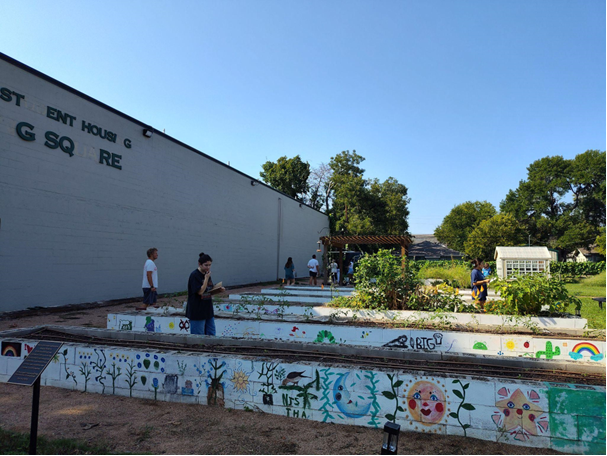
In modern America, it can be hard to always see refugia through our daily eating habits or in how food is grown. But, being that a very large percentage of citizens are not farmers, there are a few things we can still do in our own homes that care for the earth in a way that aligns with Biblical scripture. There is an unfortunate trend of overconsumption and high levels of waste that we contribute to daily. Many things we buy are wrapped in plastic, fast food comes wrapped in layers of paper, we over-buy at the grocery store and are left with half a dozen eggs to throw out and a whole pack of arugula that needs to be tossed ASAP. But what about building awareness at the grocery store? What about eating out less? What about keeping a compost bucket in your tiny apartment so that when you do have arugula that spoils you can do something fruitful with it?
In reading Pope Francis’ Ludato Si’, I was inspired to go back to Genesis, to think over the way we are designed to live in harmony with the earth. I began meditating on Francis’ analysis of the term “tilling,” and how man is created to cultivate and care for the earth that God calls “good.” We followers of Jesus, made in the image of God, are made to mimic the Lord and the way that He loves and cultivates life. To live as an image-bearer of God is not to disregard the amount of waste that is put into this earth daily, but rather it is to feel a passion and empathy with the earth for the ways it has already been harmed. I believe our calling, going forward as Christians, is to practice organic living as best as we can with the resources we have.
I know that I, along with other college students, struggle with budgeting at the grocery store – often opting for the cheapest option of what is available. But I believe that even making one decision to buy part of my weekly produce from organic growers can be beneficial. It’s the small things like these that count, that add up to bigger things that can make a difference in our immediate communities. Seeing Kay Bell’s work, for example, at Global Revive was so encouraging. Seeing someone practice organic growing and eating with the intention of caring for, fostering, and educating her community ultimately reminded me of my purpose as a living and breathing and eating human being. Whether it’s through attempting to shop more often at the farmer’s market to buy organically from smaller growers, or composting the scraps that I failed to use in my kitchen each week, there are ways for my daily and weekly habits to glorify God for the gift of earth that He has given us dominion over.
Creative Invitation
Introduction
In considering what form of creative composition I wanted to do for this reflection, I quickly realized that poetry would best reflect the thoughts I wanted to share. I love poetry’s ability to convey connections and images that readers most likely would not have made without the poem.
I chose to write a small collection of three poems, titled “Trees,” “Fruit,” and “Joy,” reflecting creation’s different stages of being in unity with God, falling short of His glory from the effects of sin, and being eventually redeemed by the blood of Jesus who points us to the ultimate hope of restoration. I reflected heavily upon Pope Francis’ LudatoSi’, namely Chapter Two, titled “The Gospel of Creation.” In Paragraph 70, Francis discusses the Biblical narrative of Cain and Abel, which is a story that truly captivates me and forces me to pause to consider the ways that the brokenness of this sinful world affects man’s relationship with earth. Work, and our process of “tilling” and cultivating the earth, is meant to be joyful, bringing us closer to God. But as Cain is punished, working with the land becomes toilsome. So, until the day that Jesus returns for the second time, it is a mission of ours to acknowledge the interdependence humans and earth have with one another, and to attempt to live as close as we can to the model set for us in Eden.
My first poem, “Trees,” is meant to reflect Creation, and how everything is designed to glorify the Lord. My main inspiration for this piece came from Christina Rosetti’s poem, “All Thy Works Praise Thee, O Lord,” and how crucial the concept of unity is when considering the Creation narrative. Rosetti makes it clear that not only is everything under the sole power and control of God the Creator, but that everything is made for His glory and His glory alone. When someone reads this first poem of mine, I hope they are able to reflect upon the simplicity of nature’s beauty, but also its complexity as it mirrors the unfathomable love of God. There are things about God that we people can never comprehend, but nature offers us a taste of the Lord’s goodness in a language we can understand.
My second poem, “Fruit,” is a piece that reflects upon the first sin, the story of Cain and Abel, and the way that the earth responds to our brokenness. I wanted this piece to reflect the human qualities that nature possesses, that it speaks to us and shows us when it is hurting and when it is thriving. Unfortunately, the effects of Cain’s mistakes are still with us. I firmly believe, though, that the global disasters happening around us each day should move us to repair what we can in our communities, which leads to the purpose of my third poem.
My last poem, “Joy,” is meant to reflect both the image of Jesus’ death on the cross, and the practice of composting. Two images that do not seem like they belong together actually felt so strongly tied in my mind while writing this. Upon integrating small practices of refugia in our daily lives, we mimic what we can of the type of restoration Jesus will eventually bring in fullness – filling the earth with so much joy.
Trees
It was all made for you,
The stars, the hills,
the trees, all for you
His very breathing, filled
by you, sings for you
He sings to you, the birds
of the trees echo the song
that angels taught, the first
very day they were alive
There the man, with dark
hands, tirelessly works,
his work marks the voice
of you, the love of you, it’s
all for you, and by choice
you let him come in, and
see the fruit.
Fruit
But the citrus
bursts, and blood pours
out like wine
A hand squeezes
and squeezes as
the fruit pops
Its blood thick
and red runs down
his tanned wrist
A mother watches
her oldest baby walking
towards the stones
Joy
The dry grass
drank it in, the red
fruit’s blood, asking
what is this mystery, let
the rain flood and make you
new, that tree on that hill ached, he bled
until all the red spoiled fruit
was fresh again, healthy
and in unity, spilling
joy in the grass.
Works Consulted
Francis. Ludado Si’: On Care for Our Common Home. Vatican Press, 2015.
Rossetti, Christina. “All Works Praise Thee, O Lord: A Processional of Creation.” The Complete Poems. Penguin Classics, 2001.
“Urban Reap.” Mission Waco. https://missionwaco.org/urban-reap/.