

Scarcity by Design
by Breonne Benoit for Dr. Joshua King’s ENGL 4365: Literature and Environmental Justice class, Fall 2025
Welcome
Hello everyone, I would like to welcome you! I hope my reflection provides an insightful motivation that calls you to contribute to communal change and progression. I want you all to understand the severity of resource scarcity within our local communities. The most important takeaway I urge you to consider is your communal involvement. Your communal involvement contains the power to invoke change and foster growth beyond self. I hope you find motivation to foster nearby communities and take initiative through daily practices.
Reflection
Throughout the semester, I was able to learn much by participating in the course. While when I first signed up for the course, I was unaware of what it would entail; I’m thankful for doing so. As a child, my parents made it apparent that being outdoors was something children were supposed to do. Growing up, I was extremely close to my great grandmother. She fostered her own garden that remained in her backyard. I have this sweet image of her: watering plants and cutting away faulty stems. However, I was unaware that this was a foundation. A foundation that led me to grow a fond appreciation for what I now know as refugia.
The course led me to participate in an action that I never considered: composting. While tending to a garden and volunteering with nearby communities was nothing new, composting was unknown to me. Prior to joining Dr. King’s Literature and Environmental Justice course, I didn’t know what composting was nor did I understand its impact. I understood that there were many ways to foster community and preserve land; however, I presumed that actions like recycling plastics and participating in community volunteering were the only ways to foster refugia. However, composting changed my perspective.
During my time at Urban Reap, there were many tasks to participate in: sifting through waste for composting, tending to the plants in the greenhouse, cleaning the volunteer site with eco-friendly supplies, and more. I participated in each task which was very enlightening. The composting was insightful. Although we were practicing our own composting at home, it was great to participate in one that included a community that was unfamiliar to me.
At the greenhouse, my group heavily focused on cleanliness and planting. We focused on cleaning the space with eco-friendly supplies and planting new seeds to foster growth and resource access. As I participated in these tasks, I was enlightened that Urban Reap uses the resources grown to supply local food pantries in Waco. These pantries help provide Waco residents with necessary food and personal resources. I found this to be heart-warming, but more importantly I felt blessed to be one to contribute to such an influential and beneficial cause. Moreover, I began to reflect, as I wondered how I could further contribute to a cause like such every day.
At Urban Reap I felt that I was participating in a direct role that led to the support in strengthening Waco’s environment. I became educated about the local community, equally recognizing that participating in everyday wasteful activities is producing more environmental harm and bondage than not. I felt that Urban Reap uses their space to maintain growth, meaning their space is intended to produce growth through communal involvement, advocacy, and resource support.
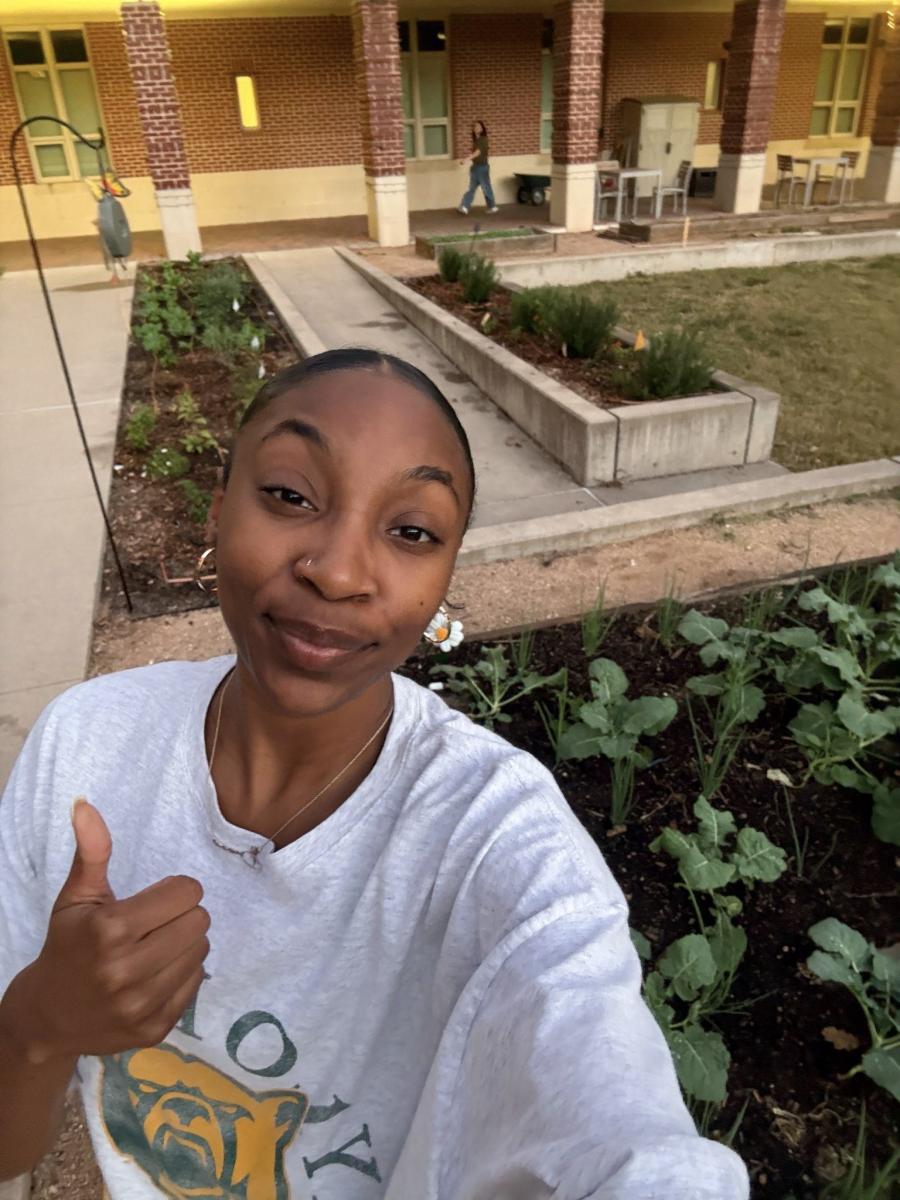
Through my time at Urban Reap, I recognized that Waco’s community is heavily seeking proper access to daily resources. Moreover, the presence of environmental injustices is something we discussed throughout the semester. So, it was quite daunting to recognize and understand the severity of environmental injustice and harm in the community through volunteer work. At Urban Reap there were flowers and other plants available for purchase. What was quite enticing about this, was simply that they were grown on the site. Moreover, my time at Urban Reap caused me to recollect the importance of refugia. Refugia occurs through recognition and communal cultivation. Through fostering the environment, it creates a refuge for life in all aspects and it helps enhance the environment’s resistance to outward disturbances.
Upon reflecting on my time at Urban Reap, I have grown a new fond appreciation for environmental preservation and communal participation. I have recognized the presence of resource scarcity and its prominence within my community. Further, I understand that city involvement is important in order to reduce scarcity at any capacity. Unfortunately, some communities are designed by states and cities to experience scarcity at some capacity. However, fostering refugia is something larger than tending to flora or plants, but rather it’s a contribution to further cultivate life and prevent environmental injustice.
Creative Invitation
Introduction
For my creative invitation I chose to write a poem. This poem was heavily influenced by Eve Ewing’s “July, July!” poem, a work read this semester. In “July, July!” Ewing focuses on the detrimental impact of the urban heat within specific African American communities. However, I incorporate Ewing’s ideology, but I chose to reflect on other environmental injustices that heavily impact our communities.
Moreover, this poem is designed to story tell, providing the reader with insight into the tragedy of communal resource scarcity. The poem is influenced by one of the largest homeless populations in the United States: Skid Row. The beginning of the poem is intended to define home and community through metaphorical and physical gestures. I work to define home and community through the presence of resource scarcity. Thus, implying that the ability to cultivate a home is possible through community, despite given circumstances. Moreover, I focus on the usage of necessary resources and showcase how their scarcity impacts communal bases.
I use a very specific and personal example in the poem, representing the presence of water scarcity. Throughout the poem, I showcase how community is ultimately the solution to resource scarcity. Throughout the poem I reference how a community like Skid Row is perceived from the outward gaze, however I make the truth of the community’s identity the focal point. I intended to use more humane language to bridge the gap between social hierarchy and social poverty, proving that we as humans are one. I was influenced by Eve Ewing’s repetition within the poem “July, July!”, as I found that Ewing incorporates this tactic to draw the reader to an important concept within the piece. I adopted a similar tactic by repeating specific words and intricately using each stanza to invite the reader into a different perspective and/or dimension of the community itself. Near the ending of my poem, it is written as a call to action. It holds other communities accountable and addresses that the socially superior should work to support and help impoverished and low-income communities. Moreover, I present the presence of equity because despite differences we possess similarities. Community is not judgement. Community is recognizing the need to foster one another.
Still Flows
Nothing is promised.
Not water.
Not food.
Not warmth.
Water arrives through flowing city streams,
sometimes clean, mainly polluted.
Food comes through sharing;
cousins, sisters, and brothers.
Warmth is bundling together,
using the same distressed fabric.
Some call it scarcity,
but we call it home.
Walking down the street,
I see Jada.
Her hands reach over the plastic tarp,
handing Eddie her half full water bottle to share.
Jada is 6, Eddie is 22.
She remembers those close to her,
Only repeating what she sees.
This is healing.
It doesn’t happen through grand gesture,
but exchange.
A water bottle with clean water.
A warm blanket.
A shared meal.
An environment intended to be our downfall,
forms into an unbreakable community.
Our scarcity is by design.
Cities profit and forget us along the way.
We persist, they resist.
Our care is our community,
but scarcity is to be few.
Support is necessary.
Don’t just walk our streets,
Don’t just look at us
with disgust.
Use your voice,
as ours has been silenced.
Understand that we are you.
Not the poor.
Not the lazy.
Not the helpless.
We are community.
Works Consulted
Ewing, Eve L. "July, July!" 1919, Haymarket Books, 2019, pp. 63–64
“As Ash Rained down on L.A.’s Skid Row, Clean Drinking Water Grew Scarce.” NBCNews.Com, NBCUniversal News Group, 29 Jan. 2025 www.nbcnews.com/news/us-news/ash-rained-ls-skid-row-clean-drinking-water-grew-scarce-rcna189658.
Miller, Julie. Recovery Writer and, et al. “The Cycle of Homelessness and Addiction on Skid Row.” Cornerstone Healing Center, 15 Jan. 2025, www.cornerstonehealingcenter.com/resource/inside-skid-row/.