

Stepping Outside of Your Comfort Zone by Stepping Outside
by Olivia Chhlang for Dr. Joshua King's ENGL 4365: Literature and Environmental Justice Class, Fall 2025
Welcome
I’m Olivia Chhlang, a Journalism and English double major and currently a junior. This class was added to my registration plan very last minute, but I believe it has been the most formative class I’ve taken so far. I hope you find my creative reflection relatable, and it helps you to think about your own feelings in considering gardening in a way that can help you find something new about yourself much like I did. In order to learn how to garden, you have to learn and accept that you are capable of gardening.
Reflection
I’ve never been much of an outdoors person. I’m not a fan of hiking, or camping, or fishing... or basically anything to do with nature and physical activity. Paired with my fear of bugs and my allergies, outdoors hasn’t been a place that I could see myself in. Gardening was part of that. I’d always watched my grandparents or my dad garden and water the plants, but I didn’t offer to partake with them. I didn’t want to get my hands dirty or have the occasional bee fly across my face, and I was content with coming to terms with the fact that I would never be an outdoors person.
When placed with the task of volunteering at the Teal Community Garden, I wasn’t sure what to make of it. I still stuck with my steadfast belief that I was just not made to be a gardener. We were tasked with planting the pollinator patches and then coming back a couple times during the semester to tend and check up on them.
The first day out at the garden, I was a little nervous. We met with Dr. King and one of the SCRAP partners who gave us a tour of the garden and the patch we would be cultivating. What was super meaningful to me was the fact that they gave us liberty and trusted us to choose how we wanted the patch to look like and think about what plants and flowers would look good next to each other while also protecting the milkweed. After that, we planted them in the soil and watered them.
Throughout the course of the semester, it would be our job to do this again, only without the help of our classmates and without the supervision of Dr. King. This was the scariest part for me. I was the strictly “no outdoors” and “no hands-on" girl. But after the first introduction in class, although I was timid in not wanting to accidentally rip a leaf off the plants or water the soil too much, I was able to accomplish the goal of planting the pollinator garden with my classmates.
Before I knew it, I had completely ignored the labels I had set up for myself. I wanted to be hands-on and I wanted to check on the garden more frequently. I found myself thinking about the garden more and more. When I went to go eat lunch at East Village, I found myself stopping by the garden afterward, and I started actively searching for pollinators, even though I thought I hated the sound of buzzing and watching insects crawl around.
Even on the hot days, the rainy days, or the oddly cold days, I was thinking about the garden. When I went to tend to the garden on the days I signed up for, I spent a lot of time there, making sure I didn’t stop in between classes so that I could maximize my time. I would always go straight to the shed, pick out a pair of gloves, and walk to the pollinator patch.
A couple of months ago, I probably would not have gone out of my way to put on random gloves from a shed by Teal Residential College, but now they weren’t just random gloves. They were my way of being able to tend to the garden and really get in deep in checking the soil and feeling the leaves without getting milkweed sap on my hands.
Being conscious of those facts alone, where I suddenly knew how much water to shower onto the plants, what pests to look for that might be affecting them, and how to trim the leaves, made me realize that I had learned so much in such a short amount of time.
Not only had I learned simple acts of gardening and tending to plants, but I had learned more about myself too. That’s what I believe is the strongest thing I can take away from my time at the Teal Community Garden.
Gardening wasn’t something that I thought I could be capable of. But by starting somewhere, I found enjoyment and comfort in it, knowing that the garden was something that I had been able to take care of right from the beginning.
Maybe I’m still not an outdoorsy person, but I don’t have to be in order to cultivate something meaningful like a community garden. Just as Dr. King and the SCRAP partners trusted us in starting the pollinator garden, I learned to put trust in myself that I would be able to step outside of my comfort zone. I found something new about myself that I never would have found without making that initial step and no matter how small, you’ll never know where it could lead you.
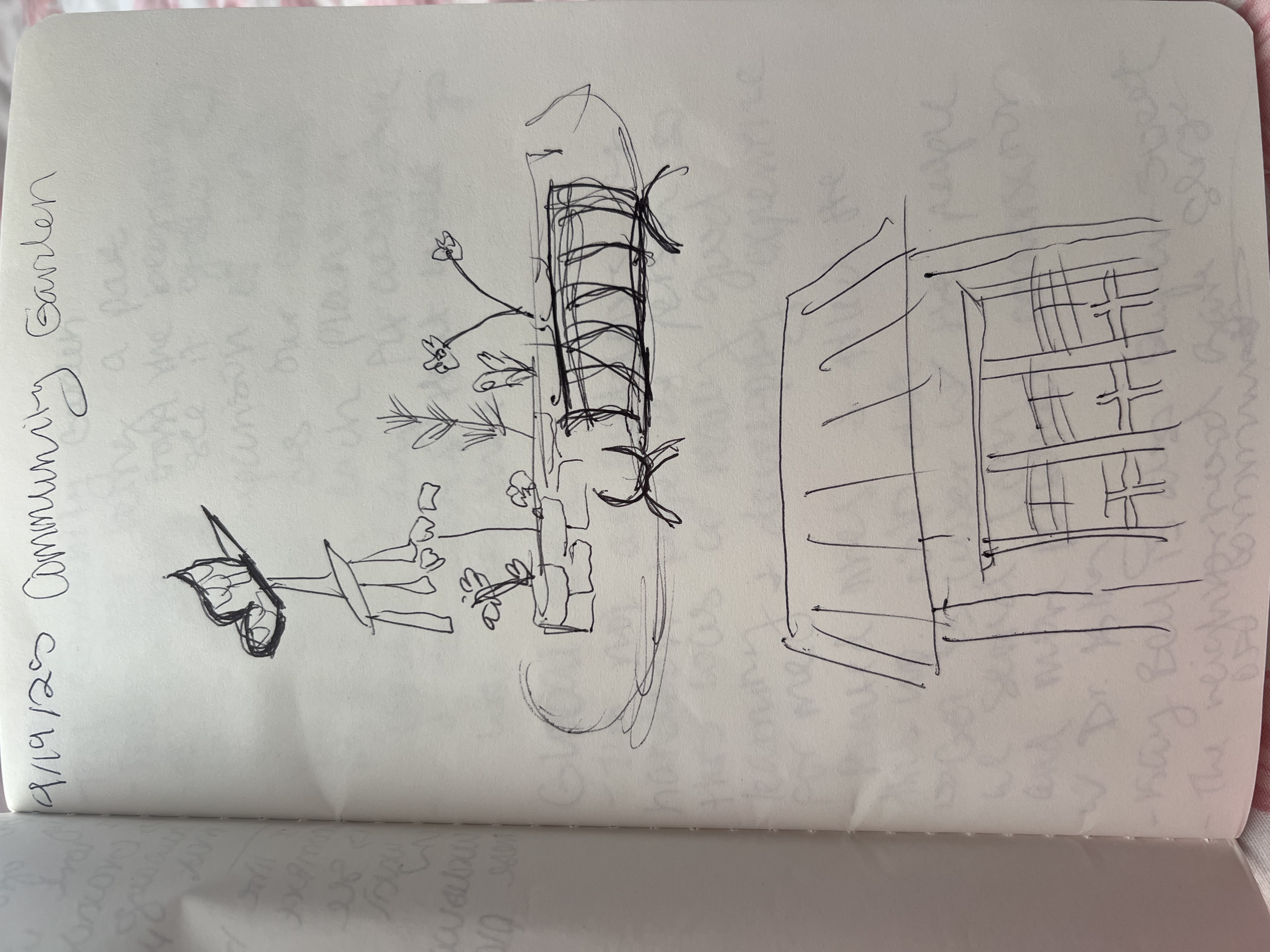
Creative Invitation
Introduction
Through my time in this class, the one thing I thought was the most formative in cultivating refugia, was learning how tending to a garden can lead to a refugia in yourself. No matter how you feel about yourself, you learn that you are capable of taking care of another living thing. And if that’s possible, you are also indirectly taking care of yourself. A plant and a human have similar needs. They thrive by being nurtured.
I also thought of this idea of refugia as something that doesn’t have to start from scratch, but by taking something that already exists and making it better through constant care. I felt that a sense of nurturing connected me to nature and the things around me, as it made me stop and think about what I can do for myself and the environment every day.
The contemporary poet Kathy Jetnil-Kijiner also experiences this connection between her land in the Marshall Islands and her identity, which she elaborates on in Poems from a Marshallese Daughter. I agree with this belief, and I tied it in with the fact that a strong connection with the land around you can allow you to take care of yourself. If you can’t take care of yourself, you’ll be unable to take care of your land.
I wanted to write poems that reflected Jetnil-Kijiner's writings, especially the way she purposefully shapes the poem whether that be literally or with deliberate pauses and inflections. I think shaping the poem in this way makes the emphasis apparent and draws the reader to its importance, which is something I wanted to incorporate into my own poems. I like how the pauses force the reader to reflect on Jetnil-Kijiner's words. What did she mean by this? Why did she choose this word specifically? Her poems are also not meant to be read separately, and I like how each poem builds on one another, enforcing her overarching theme. I hope to achieve this same feeling through my poem “You” and be able to help readers see how finding yourself is such an important factor when cultivating refugia.
You
rise grow,
The baby blossoms and
Just like they always do.
On a rainy day.
On a sunny day.
And what about you?
On that rainy day or
On that sunny day
rise grow?
How can you and
Even if you don’t want to—
Without that first
step
then you’ll never know.
To tend to the garden each day,
You have to tend to yourself
In a simple way.
On a rainy day.
On a sunny day.
You’ll find the garden remains.
However, you don’t seem unchanged.
You went to the garden
Yesterday.
Today.
Tomorrow.
The baby blossoms are growing too.
They look peek through.
at your that smile
face and see
You make sure the blossoms rise and grow,
It’s not something they always do,
Not without the help
Of people
People like you.
Works Consulted
Jetn̄il-Kijiner, Kathy. IEP Jāltok: Poems from a Marshallese Daughter. The University of Arizona Press, 2017.