

Tomato Juice Stain: What Care Leaves on the Body
By Elianna Narducci for Dr. Joshua King’s ENGL 4365: Literature and Environmental Justice, Fall 2025
Welcome
Welcome to Tomato Juice Stain: What Care Leaves on the Body, a reflection and poem in which you are invited to pause and consider how labor and responsibility leave traces in our bodies and souls. Following the image of a fresh tomato grown in the Baylor Community Garden, this piece explores how refugia grows through attention, consistency, and stewardship.
Reflection
At the start of the semester, I understood environmental justice primarily through large-scale structures, policy, systemic frameworks, and crises that resisted personal intervention. However, I did not perceive a garden as a site of environmental justice; I mainly thought of it politically. Gardens, as I have learned during this class, directly contrast my original interpretations. Originally, I reflected on gardens as being small, local, and separate from needing urgent repair. That notion completely shifted as I participated in this class, directly experiencing the power of refugia that these little pockets of peace hold. Through the Baylor Community Garden and volunteering with SCRAP at Urban Reap, my experiences not only reframed how I defined justice, but physically showed me its importance, and how it is something practiced through return, attention, shared care, and reciprocation.
Sitting quietly on a corner, the Baylor Community Garden is not dramatic. In fact, before this class, shamefully, I never even noticed it. Shaped by seasons, care, and labor, and easy to pass by, as small as this space may appear, it harbors the most life that I have seen anywhere in Waco, Texas. Every vine, every garden bed, every blade of grass, and every speck of soil reveals the vast intentionality, maintenance, and decisions that went into the creation of this space. What is planted, how to tend to the soil, when harvest begins, and how to share what grows demonstrate how each choice is an act of care.
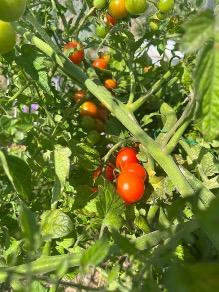
When we were told class would be hosted in the garden, I was eager to arrive early and enjoy the warmth of that morning. When I got there, I sat on a bench waiting for the rest of the class to arrive. In that moment, where I sat in silence, dew covering every surface and the quiet murmuring of insects, I just observed. I saw that this place was sustained not for spectacle, but for the nourishment of the community and the soul. A handful of red, round, divine creations were set on the table in front of my classmates and me. Tomatoes have been my favorite food for as long as I can remember. When they were picked fresh from the vine and brought into the conversation of our class, they carried that same sentiment of quiet sustenance. These tomatoes, unlike many that I have bought from the grocery store, were not detached or anonymous; rather, they reflected the work and stewardship of my own community, harvested by someone who understands their value and offered freely. I grabbed a couple, unable to resist when I caught the herbaceous and vegetal aroma. When I ate mine, it was still warm from the sun beating down on the vine, filled with juice and flesh breaking into sugar and water. Tomato juice ran down my wrist, finding my jeans and leaving a spot. The bright and acidic flavor hit my tongue, sweet in the center but edged with tang. In the moment, the flavor felt alive, different from all of the produce I have enjoyed that is disconnected from its origins and cultivators.
On the surface, this moment may appear small; however, it made visible that nourishment is never accidental. What the tomato represented was time, patience, and return from the people who lent their hands to the garden, much of it unseen, especially by myself. I had not planted this vine myself; I had not watered it, tended to the soil, or pruned when needed. Yet, I was invited to share and receive the communal harvest and what care and devotion made possible. Eating this tomato was not merely a moment of consumption, but actively participating in a system of trust, generosity, gratitude, and altruism.
From something as this cherry-bright, compact fruit reframed my prior conception of the word refugia. As I understand it now, refugia is not a space that goes entirely untouched by human presence, but a sustained environment shaped by intentional care and shared responsibility. Refugia is less of a place and more of a practice. As we have dissected this word in class and through my own experiences this semester, what has lingered with me the most was not the taste of the tomato, but the realization that I was a recipient of care that I did not perform. Environmental justice is about advocacy and action; however, it is also about learning how to receive responsibly, which is a realization that has humbled me. It is necessary to recognize the labor that is sown into what sustains us and to not take without that acknowledgement. I now understand my role in environmental justice differently than I did on the first day of class. Environmental justice is not only enacted through visible labor, but through the art of recognition and accountability. The tomato juice stain left on my jeans that day became a quiet marker of the evidence of the care that moves through both landscapes and our bodies. This then brings the conversation back to refugia. Refugia invites us to remain conscious recipients and carry the responsibility of collective care that we have received forward with return.
Creative Invitation
Introduction
In this poem, readers are invited to consider refugia as lived and shared spaces that leave lasting, tangible evidence of their impact. By centering the image of the stain from tomato juice, this poem is asking readers to consider what often goes unnoticed around them and their community, and, most importantly, in conversations about environmental justice. Often, discussions focus on policy and neglect to bring attention to the care, labor, and responsibility that move through our land and bodies. The stain represents a reminder that nourishment is never neutral, but rather the result of attentive and collective return and stewardship.
I decided to compose a poem rather than a piece of prose because it allows space for implication and personal interpretation rather than explanation. This accomplishes a couple of things. It allows the reader to linger and construct their own image and understanding of refugia by engaging with an original image. Food is one of the most accessible entry points to environmental justice, as it is relevant to nearly everyone. However, it is also the most obscured when we are accustomed to consuming while overlooking the labor and time that go into what sustains us. Therefore, by focusing on the residue left behind after eating, this poem asks readers to consider what remains changed within us after nourishment has passed.
Throughout the duration of this class, my favorite pieces we have read have been poetry. There is something special about poetry’s ability to allow meaning to remain suspended. Often, the reader will return, reread, and sit in what is unresolved. This act mimics the nature of refugia itself. Refugia is not a closed practice or solved problem; it remains open and is shaped through repetition and ongoing care. While reading William Wordsworth and Christina Rossetti this semester, both authors who have had a vast impact on my writing throughout the years, I have been drawn especially to their attentiveness to slow and overlooked moments. Neither writer relies on spectacle, but instead allows their imagery to carry ethical and emotional weight, inspiring unique revelations in each reader. These approaches align closely with how I view refugia and with my objective for this poem. This invitation is especially important in a shared public space. By encountering this piece, readers are asked to pause and reflect on what has been tended to make their presence possible and to consider how they, too, contribute to and participate in systems of care.
Tomato Juice Stain
Warm fruit,
skin softened by the sun,
begging to split open,
dissolving delicately into sugar and water.
Red, round, and divinely created.
The vine held
what many hands allowed.
A rupture in the skin.
Dripping juice
runs down wrists,
settling into denim.
Red on skin, red on cloth,
refusing erasure.
This mark was grown,
the sweetness earned.
Nothing here is accidental.
Not the ripeness,
not the stain,
not the care accumulated in silence.
Heat remembers the day,
seed maps the soil,
hands arrive, then leave,
the nourishment houses history.
The stain stayed longer than the taste,
darkening with time, deeper into the fibers of the fabric.
It insists on being noticed.
I try to scrub,
to wipe it away.
It lightens,
but it does not disappear.
A reminder that care
and labor do not vanish once received,
that nourishment leaves a record,
On what fed and marked me.
On the body,
the fabric,
the skin,
It lingers
In memory.
Red, still warm—
Tomato juice stain.